GPT Image 2 Lingerie and Swimwear Portrait Prompts
Direct lingerie and swimwear portraiture with GPT Image 2 using garment construction vocabulary, staging as a decision, and light you can name.
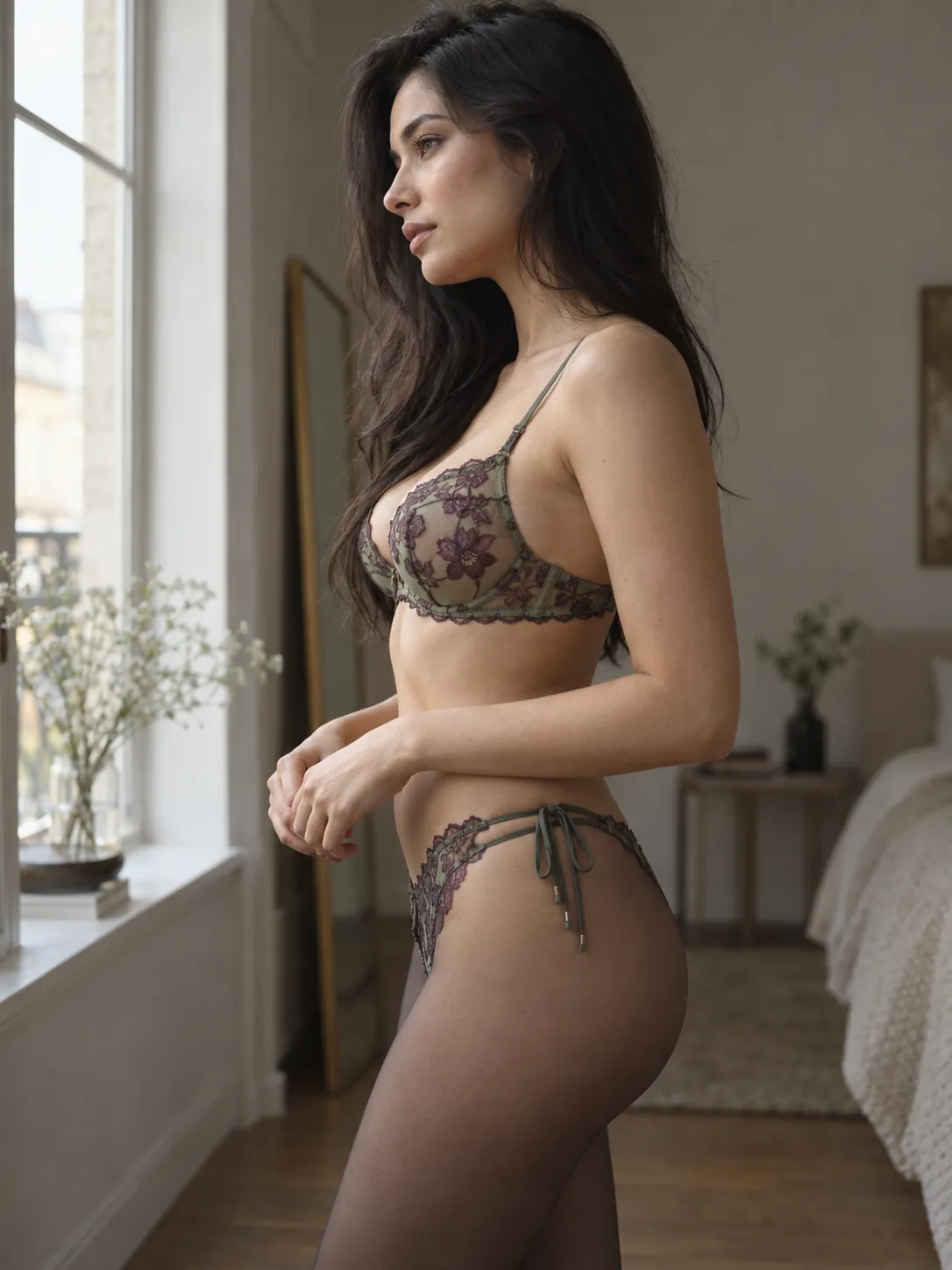
Photographing this genre with an image model fails in one specific way: the garment disappears. Write "lingerie set" and you get a woman in something generic and unnamed, because a category tells the model nothing about what to actually build. Write the construction and it renders lace with scalloped edging, double side ties, a demi cup, and a strap you can count.
The second failure is staging. A model asked for a portrait defaults to frontal, centred, and empty-handed, which reads as a passport photo of an adult garment. Every prompt below picks a camera position and a reason for it instead.
Name the garment by construction
A garment category is a lookup the model has to guess at. Construction terms are instructions. These are the ones that changed the output most:
| Instead of | Write |
|---|---|
| lingerie set | demi-cup lace, scalloped edging, double side ties at the hip |
| bikini | two-piece, high-contrast trim along the edge, matte quick-dry |
| slip dress | thin straps, straight neckline, matte satin with one specular run |
| bodysuit | opaque, structured seams, worn over leggings |
| sleepwear | loose silk camisole, thin straps, dented pillow beside her |
The third column is not styling advice. "Demi-cup" is a patternmaking term the model resolves into a specific shape, and "double side ties" is a countable object. Countable objects get drawn.
Pick the format and hold it
The strongest records in this genre all sit at 3:4, and they hold it. That is the format that leaves room for a full figure plus headroom without the subject shrinking to fit, which is what happens at 1:1 with a standing pose. Every image on this page is 3:4.
Say it once at the front of the prompt, in the first few words, and do not restate it later. A ratio named twice competes with itself.
Staging is a decision, not a pose
The camera position does more work than the pose does. Four positions cover most of what this genre needs:
| Position | What it produces |
|---|---|
| Side, at conversational distance | The silhouette and garment line. Profile against a light source separates the outline cleanly. |
| Low, looking up | Lengthens the figure and puts the garment against clean sky or ceiling |
| Mattress or waist height, tilted up | Candid and unobserved. Reads as caught rather than arranged. |
| Level, frontal, tight | Studio work where fabric texture and skin carry everything |
"Profile against a bright backdrop" beat a frontal pose every time in this batch. Backlight draws a rim along the outline, and the outline is what the eye reads first.
Give the light a job
One source, named, with a direction and a distance. The most productive prompts in this set each give the light exactly one thing to do:
- Rim and separate. Source behind the subject so a bright edge traces the profile against a muted field.
- Rake across texture. Low sun from one side, laying amber highlights along collarbone and jaw while the far side stays in shadow.
- Hard key, no fill. One narrow source at forty-five degrees, deep shadow filling the other half of the frame, everything falling off into black.
Dappled light through foliage or a textured window does a fourth job for free: it proves the subject is in a place, which a studio sweep cannot.
Six prompts
Side profile, lace construction
The reference case for construction vocabulary. Everything the model needs is in the garment sentence, so staging can stay simple.
Vertical 3:4 realistic fashion photograph. A clearly adult woman in her late twenties stands on a matte wooden floor beside a window in a minimalist apartment, photographed from the side at conversational distance so the read is her profile, waist, and hip line. She has long black hair falling over one shoulder, calm expression, relaxed shoulders, weight on one leg. She wears a delicate sage dark-purple lace lingerie set with floral embroidery, scalloped edging, and double side ties at the hip, paired with sheer tights. Soft natural window light from the left, shallow depth of field, 35mm lens, fine film grain, muted sage and cream palette, editorial fashion photography. No text, no watermark, no logo.
Why it works: "demi-cup lace, scalloped edging, double side ties" are three countable objects. "Side at conversational distance" is a camera position with a scale attached, so the model does not default to a close crop.
Backlit profile, swimwear
Same profile logic, but the light is behind her. The rim does the separating.
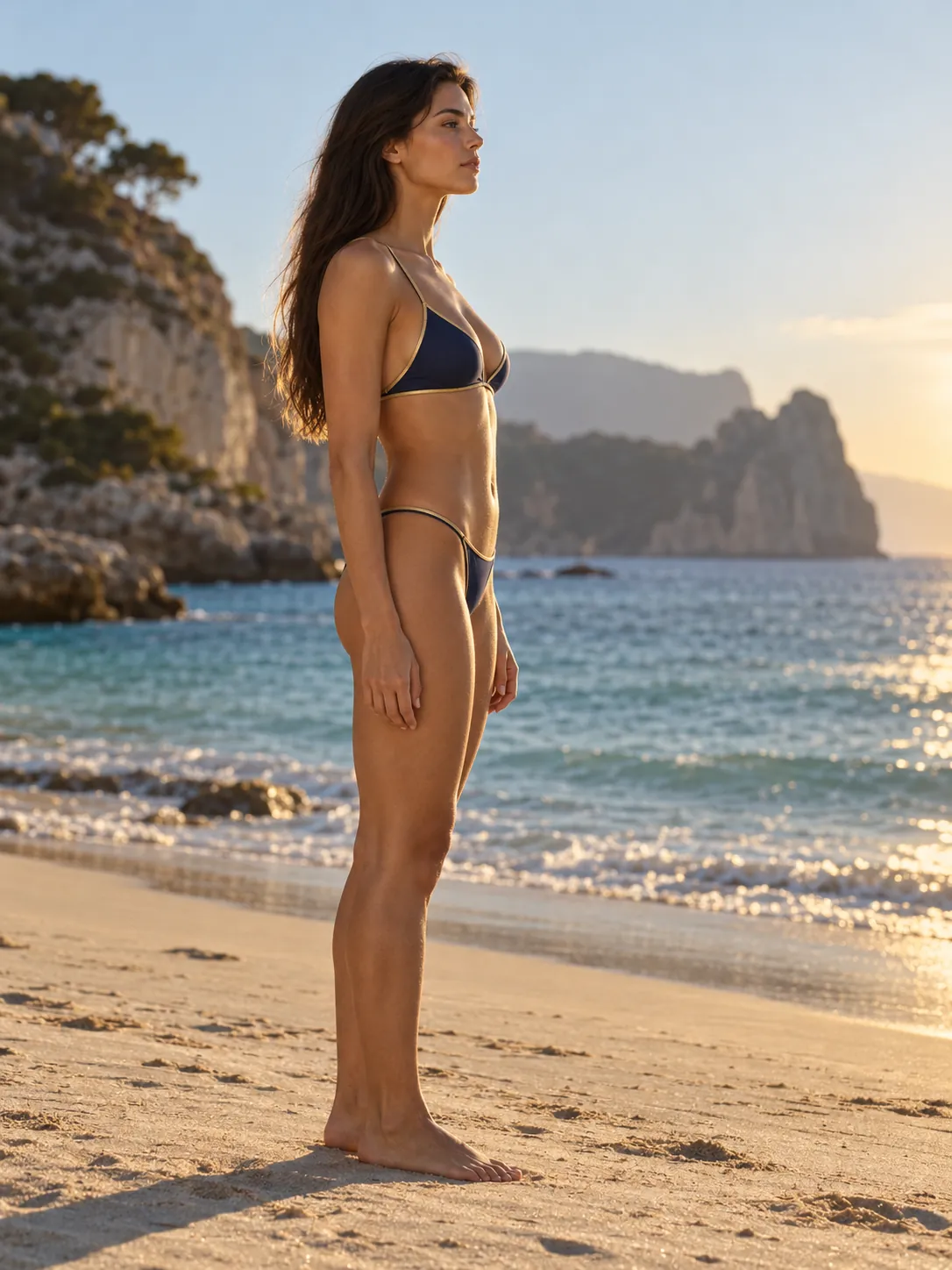
Vertical 3:4 realistic fashion photograph, profile view. A clearly adult woman in her late twenties stands in profile against a muted sky-blue backdrop, backlit so a soft rim of light separates her outline. She has long dark straight hair falling past her shoulders, calm distant gaze, arms relaxed at her sides, shoulders level. She wears a minimalist two-piece swimwear set in deep navy with gold trim along the edges, clean geometric lines, matte quick-dry fabric with a faint sheen where the sun catches it. Golden-hour side light, long soft shadow falling across pale sand, shallow depth of field, muted cool background against warm skin tones, editorial resort photography. No text, no watermark, no logo.
Why it works: "backlit so a soft rim of light separates her outline" tells the model what the light is for. Without the purpose clause, backlight tends to blow the background out and lose the figure entirely.
Suspended motion, dance studio
The hardest of the six, because a lifted leg and a moving subject fight against a sharp garment. Opaque fabric and leggings solve it.
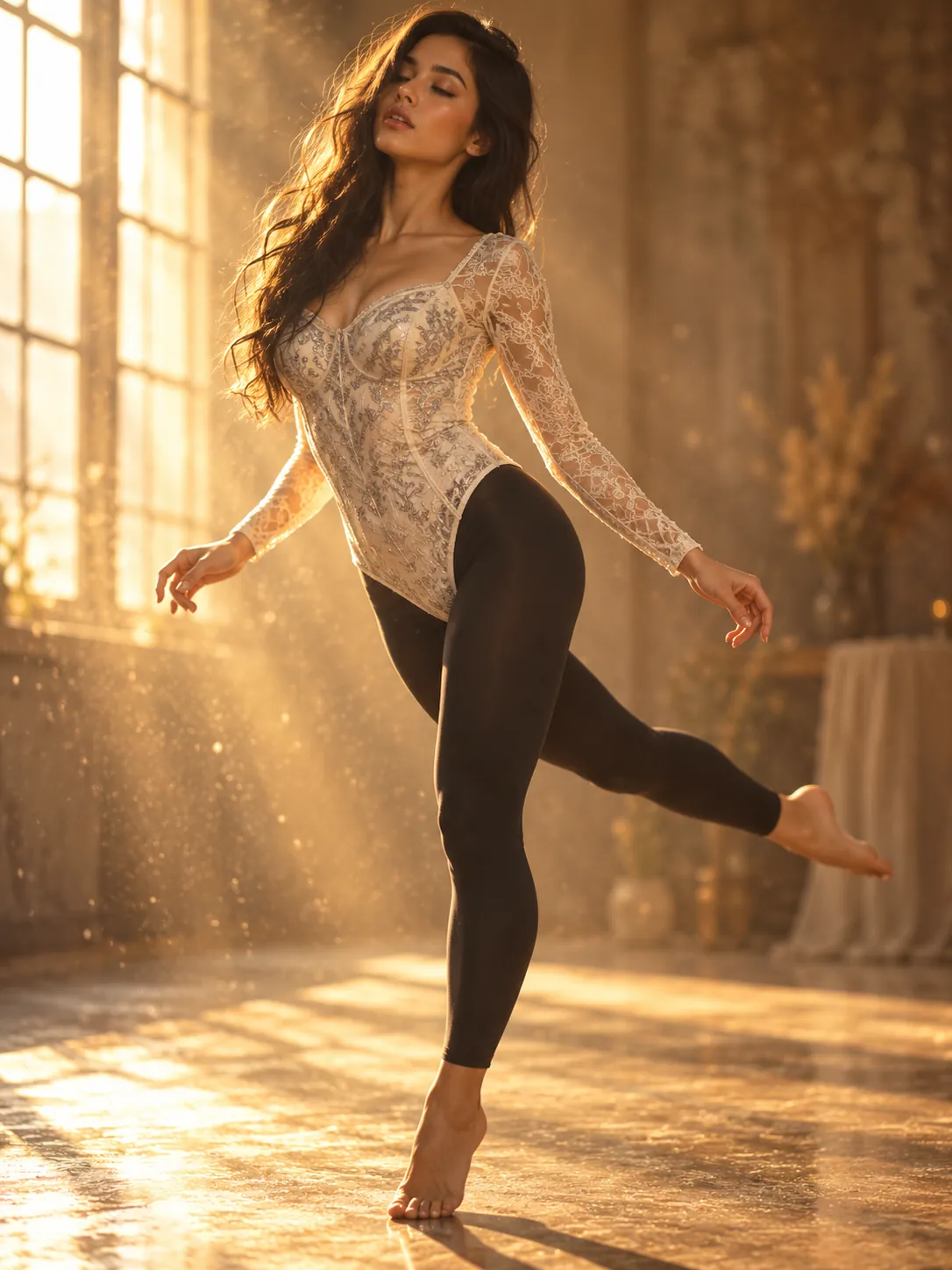
Vertical 3:4 realistic photograph, sunlit studio. A clearly adult woman in her late twenties is caught mid-movement in a dance pose, weight on one leg, the other leg extended back and slightly lifted, arms bent at the elbows with hands loose at her sides, fingers slightly curled. Head tilted, eyes softly closed, lips parted. She wears an opaque ivory lace bodysuit with silver-thread embroidery and structured seams, full coverage, worn over black leggings. Long black hair falls down one shoulder. Low-angle sunlight rakes in from the left, laying amber highlights along the collarbone and jaw while the far side stays in soft shadow. Airborne dust motes drift through the beam and stay sharp in the foreground; the background dissolves into warm golden haze. High-key cinematic lighting, rose-gold skin tones, fine film grain, shallow depth of field. Editorial fashion photography. No text, no watermark, no logo.
Why it works: dust motes in the beam and one extended leg give the frame motion without asking the model to render a blur it cannot keep coherent. The one refusal in this batch came from describing the bodysuit as semi-sheer; opaque fabric and leggings fixed it, because sheer fabric plus a lifted leg is what pushed it over.
Golden hour garden, environmental
When the garment is simple, the location has to work. Dappled light does the place and the texture in one pass.
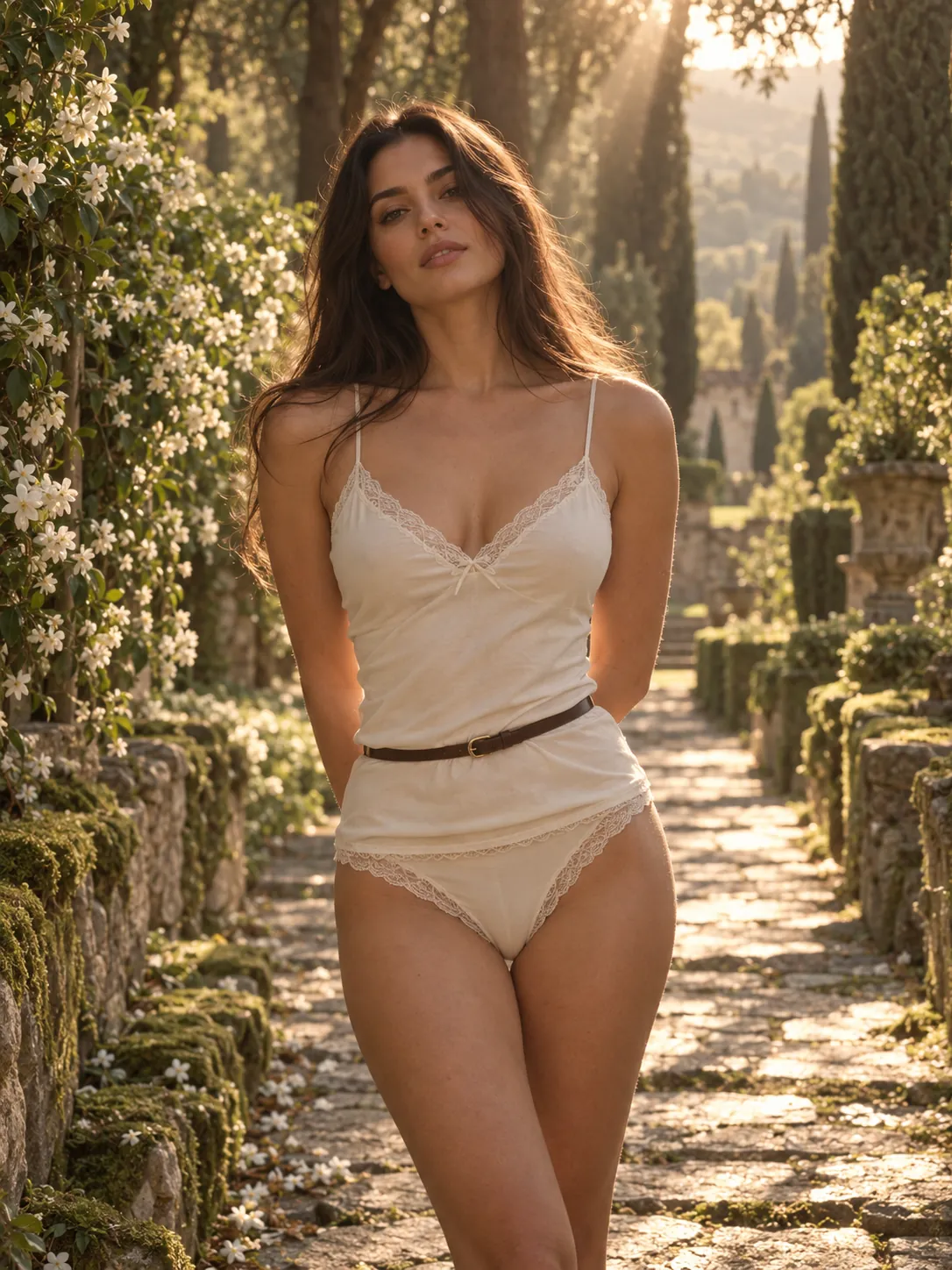
Vertical 3:4 realistic photograph, golden hour, outdoors. A clearly adult woman in her late twenties stands on an old stone garden path lined with blooming jasmine and moss-covered stones, tall trees overhead. She wears an ivory lace-trimmed camisole and matching brief, soft matte jersey with scalloped lace edging, a slim dark belt at the waist. Dark straight hair falls past her shoulders, catching the low sun. Late afternoon sun filters through the trees in long warm shafts, dappling the path and the moss. Composed for depth and symmetry, the path receding behind her into soft haze, shallow depth of field blurring the background into a dreamy green-gold wash. Warm muted palette, soft highlight bloom, fine film grain, low contrast. Editorial fashion photography. No text, no watermark, no logo.
Why it works: "the path receding behind her into soft haze" builds depth with one line and gives the shallow depth of field something to do. The jasmine and moss are the reason the light looks like it belongs somewhere.
Lived-in morning, candid interior
The opposite of a studio sweep. The garment is the plainest thing in the frame and the room carries it.
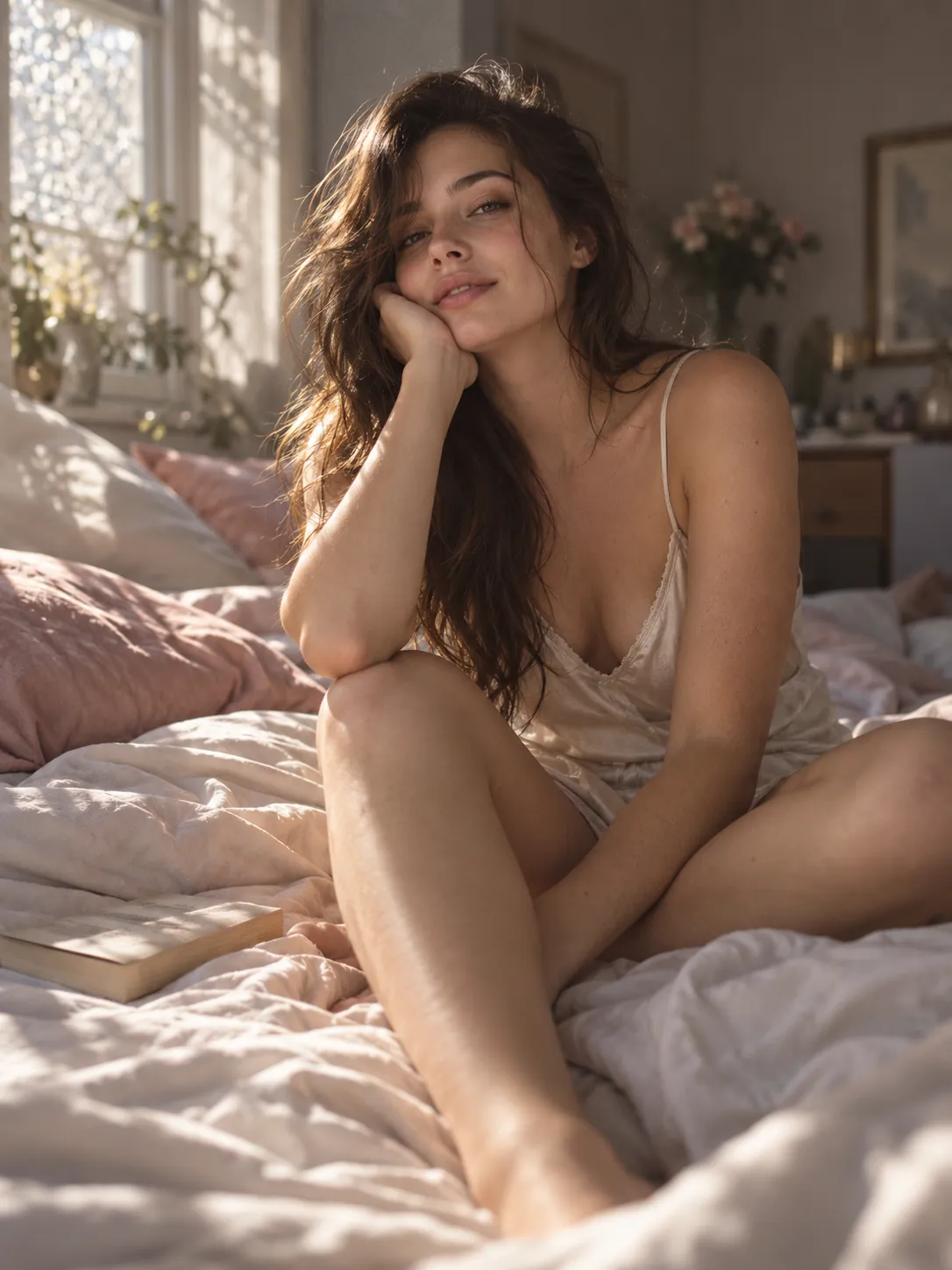
Vertical 3:4 realistic photograph, sunlit bedroom, candid and unposed. Morning light comes through a textured window and casts warm dappled shadows across a rumpled bed. A clearly adult woman in her late twenties sits on the bed with knees drawn up, legs slightly askew in relaxed asymmetry, one hand propping her chin. Dark tea-brown hair spills loose over one shoulder, a few strands across her cheek, eyes softly narrowed, lips slightly parted in a half-smile. She wears a loose off-white silk camisole with thin straps. Pillows are dented and a half-read paperback lies face-down on the sheets beside her. Camera at mattress height, about waist level, looking slightly up. Muted grey and warm pink palette, low contrast, gentle highlight bloom, shallow depth of field dissolving the room behind her. Quiet intimate editorial photography. No text, no watermark, no logo.
Why it works: "dented pillows" and a "half-read paperback" are what separate this from a bedroom render. An object at the wrong stage of use reads as a person was there, which is the whole point of a candid frame.
Low-key studio, camera as specification
The only prompt here with a full camera specification. Naming aperture and lens is how you get a specific optical falloff instead of a generic portrait blur.
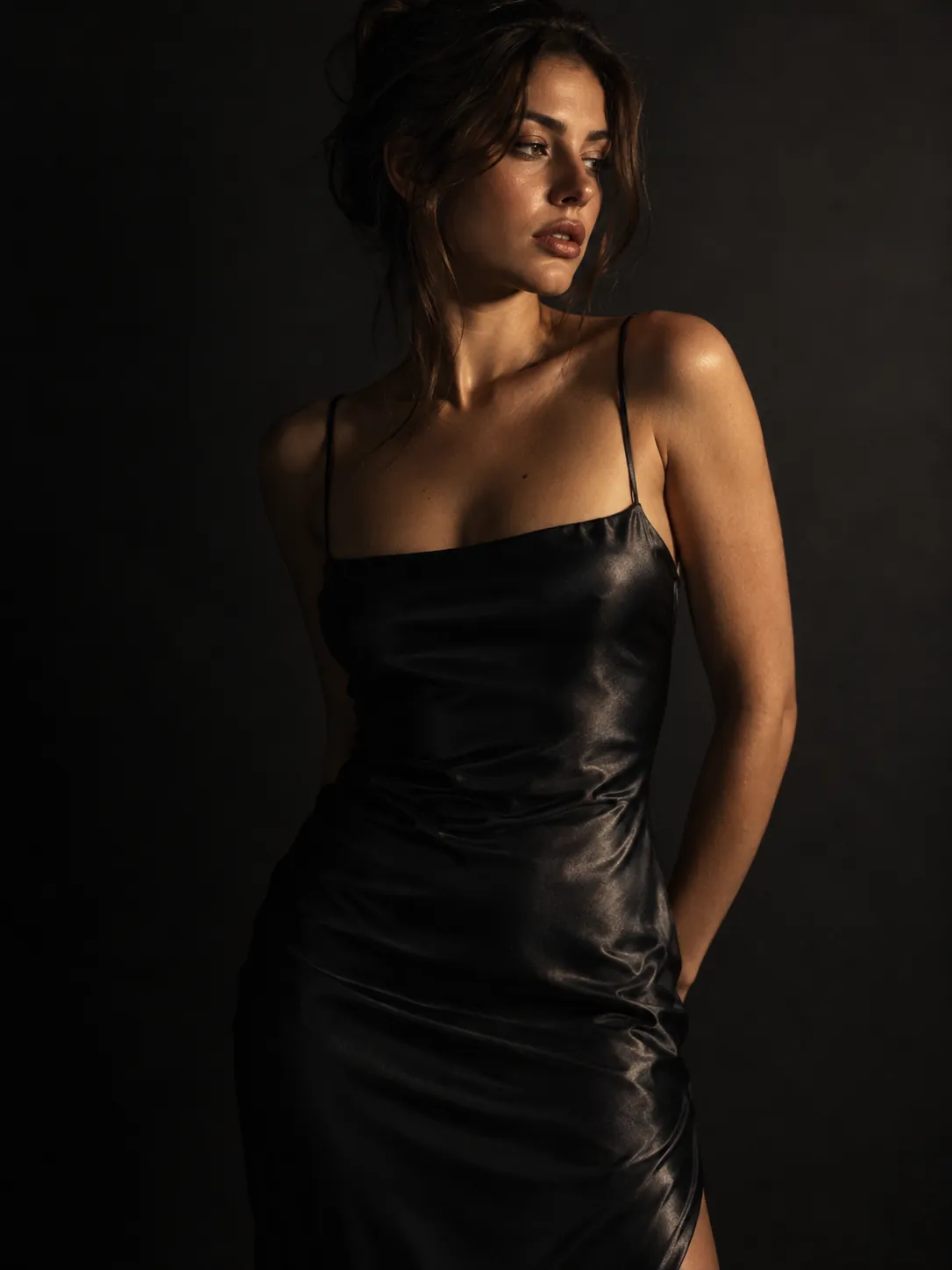
Vertical 3:4 realistic photograph, low-key studio, shot at f/1.4 on a Canon EOS R5 with a 35mm lens. A clearly adult woman in her late twenties stands against a plain dark grey seamless backdrop. She wears a matte black satin slip dress with thin straps and a straight neckline, the fabric catching a narrow specular highlight down one side. One narrow key light from the right side at about forty-five degrees, deep shadow filling the left half of the frame, no fill. High contrast, underexposed background, focus plane tight on her torso, everything else falling off into black. Warm amber tone in the lit skin against neutral shadow, fine grain, slight highlight bloom. Editorial studio fashion photography. No text, no watermark, no logo.
Why it works: "f/1.4" and "35mm" together specify how much of the frame falls out of focus and how compressed it looks. "No fill" is the load-bearing phrase; without it the shadow side lifts and the low-key effect disappears.
Swap the staging, keep the garment
The cheapest way to extend this set is to move a working prompt somewhere else and change only the light and the position.
| Move | What stays | What changes |
|---|---|---|
| Window light to golden hour | garment, side staging | source direction, backdrop, add dappled shadow |
| Bedroom to poolside | garment, candid pose | environment only, keep the waist-level camera |
| Natural to studio | garment, garment construction | replace window light with a key and an aperture |
| Garment swap, same frame | staging, light, camera position | rewrite only the garment sentence by construction |
The last row is the one worth doing most often. Hold the frame fixed and change only the fabric vocabulary, and the staging decisions you already made stay valid.
A reusable prompt order
| Block | Specify | Example |
|---|---|---|
| Format | aspect ratio, in the first few words, once | "Vertical 3:4" |
| Staging | camera position and distance or height | "from the side at conversational distance" |
| Garment | construction terms, countable where possible | "demi-cup lace, scalloped edging, double side ties" |
| Subject | age, one or two anchors, weight placement | "late twenties, long black hair over one shoulder" |
| Light | source, direction, distance, and what it does not reach | "backlit so a rim separates her outline" |
| Surface | the one texture that proves the material | "matte quick-dry with a sheen where the sun catches it" |
| Grade | lens, aperture, grain, contrast | "f/1.4 on a 35mm, fine grain, low contrast" |
| Negatives | short and scene-specific | "no text, no watermark, no logo" |
All six prompts and their example images were written and generated independently for PromptGenius. Every scene is fictional and every subject is a clearly adult person. All six images are 3:4. For the identity-lock techniques that keep one person consistent across a set see character sheets, and for the light and camera vocabulary these prompts share with portrait work see photorealism prompts.
Related Articles & Guides
 #gpt-image-2
GPT Image 2 Anime Poster and Mecha Key Visual Prompts
Build anime posters, mecha key visuals, pixel sprite sheets, and game screenshots with GPT Image 2 using layout budgets and identity locks.
 #gpt-image-2
GPT Image 2 Candid Street & CCD Photography Prompts
Shoot candid street and CCD-style photos with GPT Image 2 using direct flash, a night-street master template, film-stock color, and scene transfer.
 #gpt-image-2
GPT Image 2 Character Sheet and Reference Prompts
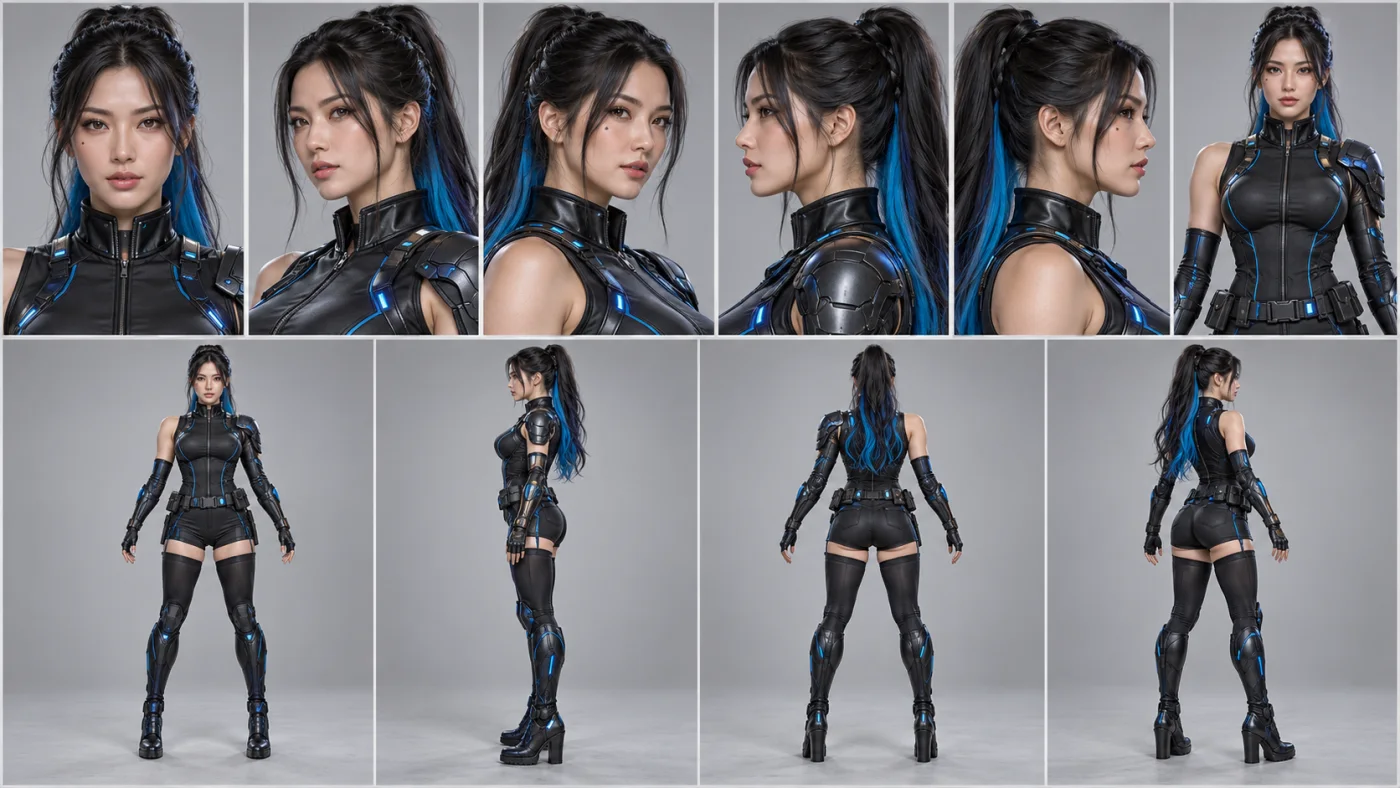
Keep a recurring character consistent in GPT Image 2 with casting sheets, expression grids, pose studies, and reusable hair and wardrobe cards.